Modern Classics
Porsche 911: The Complete History, Model Codes and Special Editions
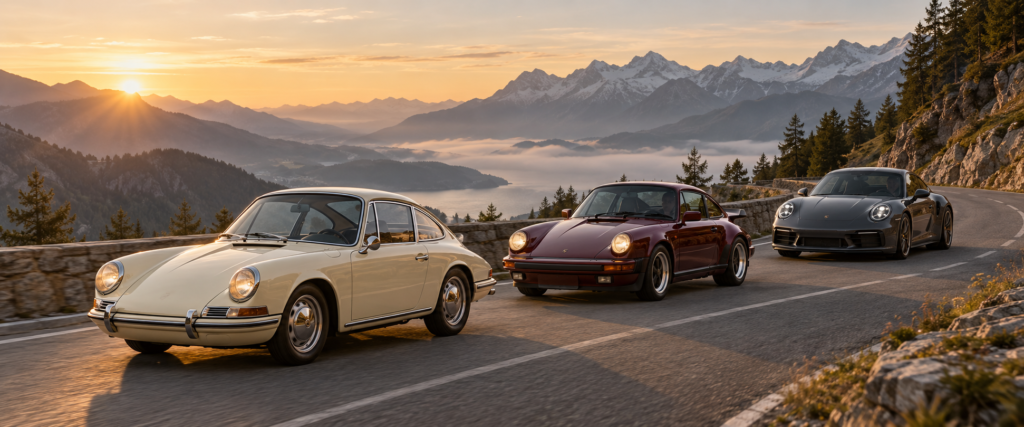
More than sixty years after it first appeared, the Porsche 911 remains the sports car by which others are judged. This guide follows every production generation from the original 901 to the current 992, explains Porsche’s sometimes-confusing badges and internal type numbers, and maps the landmark RS, Turbo, GT and factory special editions.
Few cars have evolved so continuously—or generated quite so much jargon—as the Porsche 911. To an outsider, names such as 930, 964, 993, 996, 997, 991 and 992 can look like an eccentric filing system. To an enthusiast they mark distinct chapters in one of motoring’s longest and most coherent bloodlines.
The essentials have survived since 1963: a compact 2+2 body, a horizontally opposed six-cylinder engine mounted behind the rear axle and a shape that is recognisable at a glance. Almost everything else has changed. The 911 has grown faster, safer and easier to live with; it has moved from air to water cooling, from carburettors to direct injection, from five-speed manuals to eight-speed PDK gearboxes, and—since the 992-generation Carrera GTS—from purely combustion power to a performance-hybrid system.
The 911 generation guide at a glance
| Generation | Approximate production years | What defines it |
|---|---|---|
| 901 / original 911 | 1964–1973 | The pure early shape; air-cooled 2.0 to 2.7-litre engines; Targa, S and Carrera RS appear. |
| G-Series | 1973–1989 | Impact bumpers, stronger safety structure, galvanised bodies, SC and Carrera 3.2; the 930 Turbo. |
| 964 | 1989–1994 | Traditional looks over an 85-per-cent-new car; 3.6 litres, ABS, power steering, Tiptronic and Carrera 4. |
| 993 | 1994–1998 | The final air-cooled generation; multi-link rear suspension, six-speed manual and twin-turbo four-wheel drive. |
| 996 | 1998–2005 | The first water-cooled 911; a new body and cabin, plus the birth of the GT3 road-car line. |
| 997 | 2004–2012 | Round headlights return; huge model variety, PDK, direct injection and the first GTS. |
| 991 | 2011–2019 | Longer wheelbase and aluminium-steel body; electric steering, rear-wheel steering and turbocharged Carreras from 991.2. |
| 992 | 2019–present | Wider body, digital technology and eight-speed PDK; Dakar, S/T and the first road-going hybrid 911. |
Dates overlap because Porsche normally introduced a new generation model by model rather than replacing the whole range on a single day. Enthusiasts also use “.1” and “.2” for the pre- and post-facelift versions of a generation—for example, 997.1 and 997.2.
From 356 successor to 901—and then 911
By the late 1950s Porsche knew that the 356 was nearing the limit of its development. Ferry Porsche wanted its replacement to remain unmistakably a Porsche, with a rear-mounted engine and an evolutionary shape, but to offer more refinement, luggage room and two occasional rear seats. His son Ferdinand Alexander “Butzi” Porsche shaped the decisive design, developed through the Type 754 T7 study into the fastback Type 901.
The new car made its public debut at the Frankfurt motor show on 12 September 1963 as the Porsche 901. Peugeot objected because it held rights in France to three-digit model names with a zero in the middle. Porsche replaced the zero with a one, and the name 911 was born. A small number of 901-badged cars had already been built, making them among the most historically important Porsches.
1964–1973: the original, “long-bonnet” 911
The production 911 began with a 2.0-litre, air-cooled flat-six producing 130 PS. It was compact, beautifully engineered and demanding near the limit: with much of its mass behind the rear wheels, careless drivers could discover lift-off oversteer, while skilled drivers exploited excellent traction and delicate steering.
The range quickly broadened. The 911 S added performance; the more affordable 911 T and fuel-injected 911 E created a clear ladder beneath it. The open 911 Targa arrived for 1967 with its stainless-steel rollover hoop and removable roof panel. Engine capacity rose through 2.2 and 2.4 litres, while the wheelbase was lengthened from the 1969 model year to calm the handling.
The defining early special was the 1973-model-year Carrera RS 2.7. Conceived for homologation, it combined a 210 PS 2.7-litre engine with lower weight and the now-famous “ducktail” rear spoiler. Touring and Lightweight versions were offered, and the more extreme RSR took the idea racing. The RS established a formula Porsche still follows: remove weight, sharpen the chassis and connect road cars directly to motorsport.
1973–1989: G-Series, SC, Carrera 3.2 and 930 Turbo
American crash legislation prompted the most visible change for the 1974 model year: energy-absorbing bumpers with black bellows. Porsche’s internal alphabetic model-year sequence means only the first cars were literally “G”, but enthusiasts use G-Series for the entire impact-bumper generation.
Early 2.7-litre cars gave way to the short-lived Carrera 3.0 and then the 911 SC, sold from 1978 with a durable 3.0-litre engine. Porsche briefly considered replacing the 911, but demand persuaded it otherwise. The Carrera 3.2 arrived for 1984 with Bosch Motronic management; from 1987 it gained the stronger G50 gearbox. A full Cabriolet joined the Coupé and Targa, while the low-screen, double-humped Speedster became the glamorous farewell.
The other great story was forced induction. The 3.0-litre 911 Turbo of 1975 was known internally as Type 930. Its wide arches, whale-tail spoiler and sudden boost made it a poster car and a formidable driving challenge. A 3.3-litre version with an intercooler followed for 1978. “930” therefore properly refers to this first Turbo, not to every G-Series 911. Factory Slantnose or Flachbau cars brought 935-inspired pop-up-headlamp bodywork, while the M491 option gave naturally aspirated Carreras much of the Turbo’s wide-body appearance and hardware.
1989–1994: 964, the modern classic
The 964 looked familiar, but Porsche said 85 per cent of it was new. It arrived first as the Carrera 4, using a sophisticated four-wheel-drive system descended from the 959. The rear-wheel-drive Carrera 2 followed. Both used a 3.6-litre flat-six and brought ABS, power steering, better heating, an automatically rising rear spoiler and, optionally, the four-speed Tiptronic automatic.
Porsche retained Coupé, Targa and Cabriolet bodies and later revived the Speedster. Performance highlights included the focused Carrera RS, the US-market RS America, Turbo 3.3, rare Turbo S Leichtbau and the muscular Turbo 3.6. The 964 now sits at a sweet spot for many owners: compact and unmistakably air-cooled, yet civilised enough for regular use.
1994–1998: 993, the last air-cooled 911
The 993 smoothed the 911’s shape with more laid-back headlamps and integrated bumpers. Underneath, a new multi-link rear axle made the car more stable and predictable without erasing its character. A six-speed manual became standard, Varioram induction lifted later naturally aspirated engines, and the Targa adopted a sliding glass roof instead of a removable panel.
The Carrera 2 and Carrera 4 were joined by wide-bodied Carrera S and Carrera 4S models. The 993 Turbo was transformational: twin turbochargers, four-wheel drive and enormous all-weather pace. The Carrera RS was the road-biased lightweight, while the homologation-led GT2 combined a Turbo engine with rear-wheel drive and riveted-on arch extensions. As the final air-cooled generation, the 993 has become the symbolic end of Porsche’s original mechanical era.
1998–2005: 996 and the water-cooled revolution
The 996 was the most radical 911 yet. Cost pressures led it to share architecture and components with the Boxster, including the controversial “fried-egg” headlamp theme. More importantly, its new four-valve flat-six was water-cooled, a change demanded by power, emissions and noise targets. The car was larger, lighter and roomier, and the entry-level Carrera initially produced 300 PS.
Capacity grew from 3.4 to 3.6 litres with the facelift. The family included Carrera 2 and 4, Cabriolet, Targa and the wide-bodied Carrera 4S. Turbo and GT2 models used a competition-derived engine architecture distinct from the standard Carrera unit. In 1999 the first 911 GT3 established a new road-racer line, effectively succeeding the air-cooled Carrera RS. The rarer GT3 RS made that connection more explicit.
For years the 996 was the overlooked 911. That is changing. Its smaller dimensions, analogue controls and relatively low weight now look increasingly attractive, although buyers must understand the different engine families and obtain a specialist inspection rather than relying on internet folklore alone.
2004–2012: 997, tradition with new technology
The 997 restored round headlights and a more traditional cabin while retaining the 996’s basic platform. Early Carrera and Carrera S models used 3.6- and 3.8-litre engines. The 2008 model update brought direct fuel injection to the Carreras and replaced Tiptronic with the much quicker seven-speed PDK dual-clutch gearbox.
No previous 911 had offered so much choice: rear- or four-wheel drive; Coupé, Cabriolet, Targa or Speedster; Carrera, S and, for the first time, GTS; plus Turbo, Turbo S, GT3, GT3 RS, GT2 and GT2 RS. The 997 GT3 RS 4.0 was the climactic naturally aspirated model, while the limited Sport Classic and Speedster proved that heritage-led factory specials could be as desirable as outright performance cars.
2011–2019: 991, a bigger step than it looked
The 991 moved to a significantly longer wheelbase and an aluminium-steel structure. Electric power steering replaced the old hydraulic system, improving efficiency if slightly filtering the feel. The car offered more space and composure, while active anti-roll control, rear-wheel steering and active aerodynamics expanded the dynamic envelope.
Early 991.1 Carreras remained naturally aspirated. For the 991.2 update, Carrera and GTS models switched to smaller twin-turbo engines; the “Turbo” badge nevertheless remained reserved for the flagship model line. The 991 generation also revived the T as a lighter, driver-focused Carrera and developed the GT range to extraordinary levels: GT3, GT3 RS, the 700 PS GT2 RS and the understated, manual-only 911 R. The 50th Anniversary Edition and final 991 Speedster bookended an especially rich period of specials.
2019–present: 992 and the hybrid age
The 992 kept the classic proportions but made the body wider, standardised the broad rear light bar and introduced a more digital cockpit. Carrera models used an eight-speed PDK, with manuals retained selectively. Wet Mode, advanced driver assistance and increasingly sophisticated chassis electronics broadened the car’s everyday ability.
The 2024 model update, commonly called 992.2, brought the first electrified production 911. In the Carrera GTS, Porsche’s T-Hybrid system combines an electrically assisted turbocharger and integrated electric motor with a newly developed flat-six—not primarily to chase economy, but to sharpen response and raise performance. The 992 family has also stretched the idea of a 911 in several directions: the high-downforce GT3 RS, the high-riding Dakar, the ultra-light S/T, heritage-led Sport Classic and Spirit 70, and in 2026 the open 911 GT3 S/C. Porsche says the GT3 S/C is a regular model rather than a numbered limited edition.
How to decode a Porsche 911 badge
- Carrera: the core 911. The name, Spanish for “race”, honours Porsche’s success in the Carrera Panamericana. It first appeared on the RS 2.7 before becoming the mainstream badge.
- S: a more powerful and usually better-equipped step above the standard Carrera.
- 4 / 4S: four-wheel drive, with 4S combining that system with S-level performance and equipment.
- T: originally the simpler entry model; in modern use, a lighter, more focused touring-oriented Carrera.
- GTS: Gran Turismo Sport—positioned between Carrera S and the harder-edged GT cars, usually combining extra performance with road usability.
- Targa: the open model with a fixed rollover structure. Early cars have a removable panel; later interpretations use sliding glass or an elaborate powered roof.
- Cabriolet: the conventional full-width folding-roof 911.
- Speedster: a low-screen, two-seat open special built around style, reduced weight and rarity.
- Turbo / Turbo S: the range-topping all-weather performance 911s. Since 991.2, ordinary Carreras are turbocharged too, but only the flagship carries the capital-T badge.
- RS: Rennsport, or “racing sport”—a lighter, sharper homologation or track-focused derivative.
- GT3: the naturally aspirated road-and-track line introduced with the 996; modern versions use a high-revving motorsport-related engine.
- GT3 Touring: GT3 engineering with the fixed rear wing deleted and a more discreet visual treatment. “Touring” nods to a 1973 RS 2.7 equipment version.
- GT3 RS: a more extreme GT3 with reduced weight, greater downforce and still more circuit focus.
- GT2 / GT2 RS: historically the fiercest rear-wheel-drive, turbocharged GT 911s. They sit above the GT3 line for power and rarity.
- Dakar: the high-riding, limited 992 created in tribute to Porsche’s 1984 Paris–Dakar victory.
- S/T: a lightweight 992 anniversary model whose name recalls the competition-focused 911 ST of 1969–72.
- Club Sport / Clubsport: context matters. On some road cars it denotes a stripped, track-oriented specification; on others it is a package rather than a separate model.
Internal type numbers: what 930, 964, 993 and the rest really mean
Porsche assigns internal development numbers to projects. The original car was Type 901; after the name changed, the public badge became 911. Type 930 belonged specifically to the first 911 Turbo, although it is often incorrectly used for the whole G-Series. From the 964 onward, enthusiasts adopted the factory codes as generation names.
The sequence is not mathematically tidy. Porsche numbers many projects—not only 911s—and public model names do not have to follow the internal ledger. Nor does a higher suffix always mean a better car: 991 and 992 identify generations, while Carrera, GTS, Turbo and GT3 describe positions within each range.
The landmark factory specials and low-volume 911s
There is no single official definition of a “special edition”. Some cars are true engineering programmes, some homologation models, some numbered commemoratives and others market-specific colour-and-trim editions. The list below concentrates on the significant factory-built road cars and closely related homologation specials. It deliberately excludes most race-only derivatives, aftermarket conversions and unique customer commissions.
| Era | Model | Why it matters |
|---|---|---|
| Original | 911 R (1967) | An exceptionally light competition special and spiritual ancestor of every later RS. |
| Original | 911 S/T (1969–72) | Factory competition development of the 911 S; inspiration for the 2023 S/T. |
| Original | Carrera RS 2.7 (1973 MY) | The definitive homologation 911: 2.7 litres, low weight and the first production “ducktail”. |
| Original | Carrera RSR 2.8 / 3.0 | Competition evolutions that cemented the 911’s international racing reputation. |
| G-Series | 911 Turbo 3.0 / 3.3 (930) | Porsche’s first series-production turbocharged road car and the template for the flagship Turbo line. |
| G-Series | Turbo SE Flachbau | Factory slantnose bodywork inspired by the 935; rare, costly and visually unmistakable. |
| G-Series | Carrera 3.2 Club Sport | A lighter, revvier driver’s version with reduced equipment. |
| G-Series | 911 Speedster | Low windscreen and two-seat double-hump cover; offered in narrow and Turbo-look bodies. |
| 964 | Carrera RS / RS 3.8 | Lightweight, rear-drive road racers; the 3.8 is among the rarest and most serious air-cooled RS models. |
| 964 | RS America | A US-market, simplified Carrera 2 created in the spirit of the RS. |
| 964 | Turbo S Leichtbau / Turbo 3.6 | The lightweight 3.3 and later 3.6-litre Turbo represent the sharpest 964 forced-induction cars. |
| 964 | 30 Jahre 911 | A wide-bodied Carrera 4 anniversary model, built in a series of 911. |
| 964 | Speedster | A pared-back open Carrera 2; most have the narrow body. |
| 993 | Carrera RS / RS Clubsport | The final air-cooled naturally aspirated RS, with a still more focused Clubsport version. |
| 993 | GT2 | Rear-drive, twin-turbo homologation special with bolt-on arch extensions. |
| 993 | Turbo S | An Exclusive-built, high-specification development of the already formidable 993 Turbo. |
| 996 | Millennium Edition | A numbered Carrera 4 edition for 2000, distinguished by Violet Chromaflair paint and special trim. |
| 996 | 40 Jahre 911 | A 2003 anniversary Carrera with X51 power upgrade; production was limited to 1,963 cars. |
| 996 | GT3 RS | The first GT3 to wear the RS badge, built as a lightweight homologation-focused road car. |
| 997 | Sport Classic | A 250-car, rear-drive wide-body special with double-bubble roof and ducktail. |
| 997 | Speedster | A 356-car open special created by Porsche Exclusive. |
| 997 | GT2 RS | A 620 PS, rear-drive limited model and the most powerful road-going Porsche of its time. |
| 997 | GT3 RS 4.0 | The 997’s 4.0-litre, 600-car swansong and one of the most revered modern RS models. |
| 997 | Black Edition | A 1,911-car run pairing black finishes with an enhanced standard equipment list. |
| 991 | 50th Anniversary Edition | A rear-drive Carrera S with wide body, retro details and a run of 1,963 cars. |
| 991 | Club Coupé | A run of 13 cars celebrating Porsche clubs; one stayed with Porsche and 12 went to club members. |
| 991 | 911 R | A 991-car manual, naturally aspirated lightweight that paired GT3 RS power with discreet styling. |
| 991 | Turbo S Exclusive Series | A 500-car, 607 PS flagship finished by Porsche Exclusive Manufaktur. |
| 991 | Speedster | A 1,948-car farewell using GT3-related running gear and a manual gearbox. |
| 992 | Targa 4S Heritage Design Edition | The first of Porsche’s Heritage Design collector models; 992 examples were produced. |
| 992 | 911 Edition 50 Years Porsche Design | A black Targa 4 GTS-based edition limited to 750 cars. |
| 992 | Sport Classic | A 1,250-car, manual, rear-drive wide-body special with Turbo power and a ducktail. |
| 992 | Dakar | A 2,500-car high-riding all-terrain 911 honouring the 1984 Paris–Dakar winner. |
| 992 | S/T | A 1,963-car 60th-anniversary lightweight combining GT3 RS power with a manual gearbox. |
| 992 | Turbo 50 Years | A 1,974-car celebration of the 911 Turbo, based on the Turbo S. |
| 992 | Spirit 70 | A 1,500-car T-Hybrid GTS Cabriolet-based Heritage Design model inspired by the 1970s and early 1980s. |
| 992 | 70 Years Porsche Club of America Club Coupe | A 70-car North American edition in Sholar Blue, reserved for PCA members. |
| 992 | 911 GT3 90 F. A. Porsche | A 90-car Sonderwunsch collector model based on the GT3 Touring, created for F. A. Porsche’s 90th birthday. |
Market editions, one-offs and race cars
Porsche’s catalogue becomes much larger if every regional edition is counted. Examples include the 991 Carrera S Martini Racing Edition, Endurance Racing Edition, Targa 4S Exclusive Design Edition and various Black Editions, plus recent 992 market editions such as the Japan-focused GT3 Artisan Edition, Nürburgring anniversary GT3 and Alpine-inspired GT3 Bergsport. These are genuine factory products but often combine distinctive colours and equipment rather than creating a new mechanical branch of the 911 family.
Separate again are factory one-offs created through Porsche Exclusive or Sonderwunsch, and race-only cars such as the RSR, Cup, GT3 R and 935. They are vital to the story but should not be mistaken for ordinary road-model designations. The boundary is occasionally blurred because competition homologation created some of the greatest road-going 911s.
The 911’s great turning points
- 1963: the Type 901 debuts at Frankfurt and becomes the 911.
- 1967: Targa production establishes a new kind of open sports car.
- 1973: the Carrera RS 2.7 creates the road-racer template.
- 1975: the 930 Turbo brings forced induction to the road-going range.
- 1989: the 964 introduces four-wheel drive and modern assistance systems.
- 1994–98: the 993 perfects—and closes—the air-cooled chapter.
- 1998: the 996 adopts water cooling and modern mass-production methods.
- 1999: the first GT3 begins a new motorsport-derived dynasty.
- 2008: direct injection and PDK arrive with the 997.2.
- 2015: Carrera models switch to turbocharging in the 991.2.
- 2024: the 992.2 Carrera GTS introduces the T-Hybrid system.
Why the formula has endured
The 911’s rear-engine layout began as packaging logic and became a defining engineering challenge. It gives superb traction and a distinctive way of moving through a corner. Across eight generations Porsche has progressively managed its disadvantages—first through geometry and tyres, then with electronics, active systems, four-wheel drive and rear-wheel steering—without removing the sensation that the car pivots around its rear axle.
Just as important is usability. A 911 can commute, carry luggage, cross a continent and then work hard on a circuit. The small rear seats are imperfect but useful; visibility is generally excellent; the controls have traditionally been logical. Many rivals are more exotic, but few integrate performance into ordinary life so convincingly.
That continuity also explains the extraordinary enthusiasm for tiny differences. A 2.4 S, Carrera 3.2, 964 RS, 993 Turbo, 996 GT3, 997 GTS, 991 R and 992 Dakar are recognisably members of one family, yet each offers a very different answer to the same question. The 911 has survived not because Porsche refused to change it, but because the company kept changing everything around a remarkably durable idea.
Sources and further reading
This article was researched primarily from Porsche’s own historical archive and model press material. Recommended starting points include Porsche’s official 60 Years of the 911 timeline, the story of the 754, 901 and 911, the Carrera RS 2.7 history, the official 911 Turbo generation guide and Porsche’s history of the 911 GT3.
Editor’s note: Porsche has produced numerous regional editions and individual Sonderwunsch cars. This guide covers the main production generations and the significant factory road-car editions rather than claiming that every one-off colour commission is a separate model. Details are current to October 2026.
Leave a Reply